
Alcohol-free
Apres ski without alcohol: what to drink after a day on snow
The end of a ski day is a ritual worth keeping. Here is what the day costs your body, what alcohol does in the cold, and what to put in the glass instead.
The short answer
After skiing, start with something warm and something to eat, then choose the drink. Alcohol feels warming but research shows it can delay shivering and speed heat loss in the cold, and at altitude the CDC advises avoiding it for the first 48 hours. Good alcohol-free choices are hot chocolate, tea, broth, sparkling water with citrus, a non-alcoholic beer (in the United States that can mean up to just under 0.5% alcohol by volume, so read the label), or a small shot over ice.
What a ski day costs
Skiing is real exercise. In a study of 38 recreational skiers, heart rate, perceived effort and energy expenditure rose with the steepness of the slope and the speed of skiing. Age, sex and ability did not significantly change the averages.1 You decide how hard the day is by where and how fast you ski.
The fuel matters too. A review of competitive alpine skiing reports a high rate of glycogen use during skiing, which may use up muscle stores by the end of a day of intense skiing.2 Recreational days vary a lot, so how much of this applies to you depends on the slope and your speed.
Cold adds its own cost. In seven alpine skiers doing a cycling session that simulated on-snow training, oxygen use was higher in the cold (1 degree Celsius) than at room temperature (22 degrees).3 It was a small test of racers, so treat it as a direction rather than a number.
On fluids, general exercise guidance applies. The American College of Sports Medicine says sweat rates vary widely between people, that weighing yourself before and after exercise shows your own, and that the aim afterwards is to replace any deficit. Its target during exercise is to avoid losing more than 2% of body weight to a water deficit.4 You will not weigh yourself on the lift, but it is a useful rule: after a long day on the hill, you have fluid to replace before anything else. Weigh yourself before and after one long day and you will know your own number.
Alcohol and the cold
A drink after skiing feels warming. A review of alcohol and cold explains why that is not the whole story. Alcohol gives a pleasant feeling of warmth, but with longer exposure to cold and strenuous exercise, studies show greater heat loss. Alcohol delays the start of shivering, shortens it, and adds to cold-induced urine loss. The review also says it clouds judgement about protecting yourself from the cold.5
The CDC's advice on hypothermia is plain: warm drinks can help raise body temperature, but do not give alcoholic drinks.6 Warning signs include shivering, exhaustion, confusion, fumbling hands, memory loss, slurred speech and drowsiness.7 If a person's temperature is below 95 degrees Fahrenheit, get medical attention immediately: hypothermia is a medical emergency.6
Altitude is the other half. The CDC advises avoiding alcohol for the first 48 hours at high altitude, and notes that acute mountain sickness has symptoms like those of a hangover.8 We cover the research in Does alcohol hit harder at altitude?
What to drink at the bottom of the hill
Think in order: warm, then fluid, then food, then the drink you actually want.
- Something warm. Hot chocolate, tea, hot apple cider or broth. The CDC says warm drinks can help raise body temperature.6
- Water. The ACSM position on fluid replacement is the reason to drink some before anything else.4
- Food. The ACSM joint position statement on nutrition and athletic performance covers the timing of food and fluids around exercise.9 A real meal beats a snack and a drink.
What to drink in the evening
- Non-alcoholic beer. A good option if the taste is part of the ritual. Read the label: under federal rules, a malt beverage can say "non-alcoholic" only with the statement "contains less than 0.5 percent alcohol by volume" next to it, and "alcohol free" is allowed only for products with no alcohol.10 If you avoid alcohol completely, look for "alcohol free".
- Hot chocolate. Proper, made with milk, for a dessert in a cup.
- Sparkling water. With citrus, bitters or a sprig of rosemary, in a real glass.
- Zero-proof cocktails. Mocktails are a whole category. Ask for the same glass and garnish as everyone else.
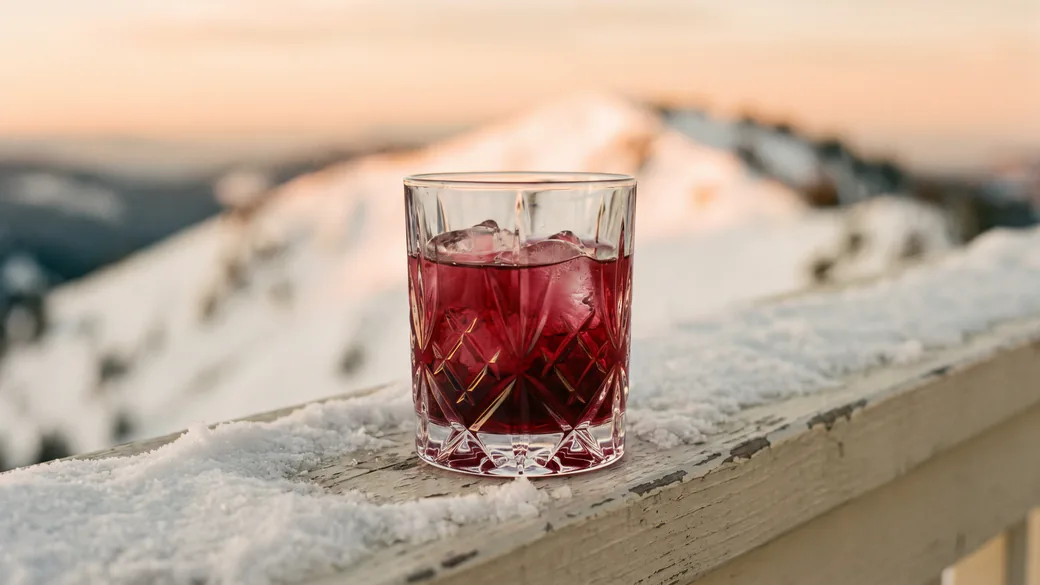
- A shot over ice. SOLACE is a 2 oz botanical shot on a berry juice base, made with eight botanical, mineral and amino ingredients. Natural ingredients. No alcohol. No cannabinoids. It can be poured over ice.
If the evening does include alcohol, finish early: the research on alcohol and sleep found that it shortens the time to fall asleep but disrupts the second half of the night.11
Keeping the ritual without the alcohol
Most of apres ski is not the alcohol. It is the pause after the last run, a table, a fire and people who were on the same hill. That part is easy to keep.
- Order first. Say what you want before the round is called, so you are not left with the water jug.
- Use the same glass. A short glass, an ice cube, a garnish. The glass does half the work.
- Make it a habit. The same drink at the same time after each day turns it into a ritual.
- Keep the toast. Clink glasses. Nobody checks what is inside.
ATLAUA arrives in Colorado in December 2026, and we wrote down the details in ATLAUA in Colorado.
Sources
- Seifert J, Stoggl T, Scheiber P, et al. Grade and speed have greater influence on HR and RPE than ability, sex, and age in alpine skiing. J Sports Sci. 2017. pubmed.ncbi.nlm.nih.gov/27103218
- Tesch PA. Aspects on muscle properties and use in competitive Alpine skiing. Med Sci Sports Exerc. 1995. pubmed.ncbi.nlm.nih.gov/7752855
- Suzuki Y, Ohya T, Ito T, et al. Physiological responses in Alpine skiers during on-snow training simulation in the cold. Int J Sports Med. 2014. pubmed.ncbi.nlm.nih.gov/24203800
- Sawka MN, Burke LM, Eichner ER, et al. American College of Sports Medicine position stand. Exercise and fluid replacement. Med Sci Sports Exerc. 2007. pubmed.ncbi.nlm.nih.gov/17277604
- Granberg PO. Alcohol and cold. Arctic Med Res. 1991. pubmed.ncbi.nlm.nih.gov/1811578
- Centers for Disease Control and Prevention. Preventing Hypothermia. Winter Weather. Reviewed 25 August 2026. Checked 27 November 2026. www.cdc.gov/winter-weather/prevention/index.html
- Centers for Disease Control and Prevention. Recognizing Hypothermia. 26 August 2026. Checked 27 November 2026. www.cdc.gov/natural-disasters/psa-toolkit/recognizing-hypothermia.html
- Centers for Disease Control and Prevention. High-Altitude Travel and Altitude Illness. CDC Yellow Book. Reviewed 23 April 2025. Checked 27 November 2026. www.cdc.gov/yellow-book/hcp/environmental-hazards-risks/high-altitude-travel-and-altitude-illness.html
- Thomas DT, Erdman KA, Burke LM. American College of Sports Medicine Joint Position Statement. Nutrition and Athletic Performance. Med Sci Sports Exerc. 2016. pubmed.ncbi.nlm.nih.gov/26891166
- Alcohol and Tobacco Tax and Trade Bureau. Malt Beverage Labeling: Alcohol Content. ttb.gov. Checked 27 November 2026. www.ttb.gov/regulated-commodities/beverage-alcohol/beer/labeling/malt-beverage-alcohol-content
- Ebrahim IO, Shapiro CM, Williams AJ, Fenwick PB. Alcohol and sleep I: effects on normal sleep. Alcohol Clin Exp Res. 2013. pubmed.ncbi.nlm.nih.gov/23347102
This article is for general education and is not medical advice. ATLAUA products are not intended to diagnose, treat, cure or prevent any disease. Speak to a healthcare professional before starting any supplement, especially if you are pregnant or breastfeeding, take medication, or are subject to anti-doping testing.