
Alcohol-free
Dry January in Colorado: what the research found and how to plan the month
A month without alcohol is easier to plan in January than to improvise on a ski weekend. Here is what the studies of participants actually measured, and how to build the month around a Colorado winter.
The short answer
A dry January is a month with no alcohol. In studies of people who took part, participants reported better well-being, and six months later they reported drinking less, though most of those results are self-reported and come from people who chose to take part. To plan it in Colorado, decide what you will order before ski weekends, après and gatherings, tell the people you are with, and keep a drink you like in hand. If you drink heavily every day, speak to a doctor before you stop.
What a dry January is, and who runs the original
A dry January is a month with no alcohol. The original Dry January campaign is run by Alcohol Change UK, a UK charity, which marks the name as a registered trademark.1 This article uses the phrase only to describe the month, and it is not affiliated with that campaign.
The campaign has been studied more than most health challenges, because the charity's participants agreed to answer questionnaires. That gives us real numbers, and also some limits worth knowing before you decide how much to expect.
What the research found
The most-cited work comes from Richard de Visser and colleagues. In a 2016 study, 857 British adults taking part in Dry January completed questionnaires at the start, after one month and after six months. Taking part was related to lower alcohol consumption and greater confidence in refusing a drink at six months, whether or not people completed the month, with larger changes among those who did. Very few people reported drinking more afterwards.2
A 2020 study of 4,232 participants found that taking part was associated with higher well-being and general self-efficacy, with bigger changes among those who finished.3 A further 2020 cohort study compared 1,192 participants with 1,549 drinkers who were not trying to stop, using surveys in January, February and August 2019. The benefits seen among people who completed the month were not seen in the comparison group. The authors also noted that participants were heavier drinkers than average and more concerned about their drinking.4
Two cautions follow. First, these outcomes are self-reported, and the people who sign up are not a random sample. Second, the results describe people who chose to try it, and say little about anyone else.
One study measured bodies rather than opinions. In a 2018 BMJ Open study at a single tertiary centre, 94 healthy people who planned a month off were compared with 47 who kept drinking. All were moderate to heavy drinkers. After the month, the abstaining group had lower insulin resistance scores (down 25.9 percent), lower systolic blood pressure (down 6.6 percent) and lower weight (down 1.5 percent), while the control group showed no significant change.5 The groups chose themselves, so this is observational evidence, not a trial.
What health agencies say about alcohol
The CDC states that the risk of some cancers increases with any amount of alcohol use, and that you can lower your health risks by drinking less or choosing not to drink.6 It defines moderate drinking as two drinks or fewer in a day for men and one or fewer for women, and notes that a single beverage can contain more than one standard drink.6
A US standard drink contains about 14 grams of pure alcohol. That is 12 ounces of beer at about 5 percent, 5 ounces of wine at about 12 percent, or 1.5 ounces of spirits at about 40 percent.7 A large pint after a day on the mountain is often more than one.
If you drink heavily every day, do not stop suddenly on your own. The National Institute on Alcohol Abuse and Alcoholism warns that stopping after prolonged heavy drinking can cause a painful or even life-threatening withdrawal, and advises seeking medical help to plan a safe recovery.8
Planning the month around a Colorado winter
January in Colorado is ski season, so the hard moments are predictable. That is useful, because a predictable moment can be planned.
- Ski weekends. Decide the evening drink before you leave, and stock the rental or cabin with it. NIAAA suggests keeping little or no alcohol where you are staying if it makes drinking hard to resist.9
- Après. Choose your order before you walk in. A hot drink, a sparkling water with citrus or a non-alcoholic beer all work. Our piece on après without alcohol covers the options.
- Holiday leftovers. The month starts straight after New Year gatherings. Clear the fridge and the bar cart on 31 December, not on 1 January.
- Days in the mountains. If you are heading higher, read alcohol at altitude first, since the evening drink matters differently on a ski trip.
NIAAA also advises picking two or three tips to try rather than changing everything at once.9
What to drink in the evening instead
For many people the evening is where a drink used to sit. Replace the slot rather than leaving it empty. Alcohol shortens the time it takes to fall asleep but increases disruption in the second half of the night,10 so an evening drink without alcohol removes that variable from your nights.
- Sparkling water with citrus and ice, in a proper glass.
- Hot tea or a warm non-alcoholic drink if the evening is cold.
- A non-alcoholic beer, if you like the ritual of a bottle. Check the label: under US labelling, "non-alcoholic" means less than 0.5 percent alcohol by volume, and only "alcohol free" means 0.0 percent.11
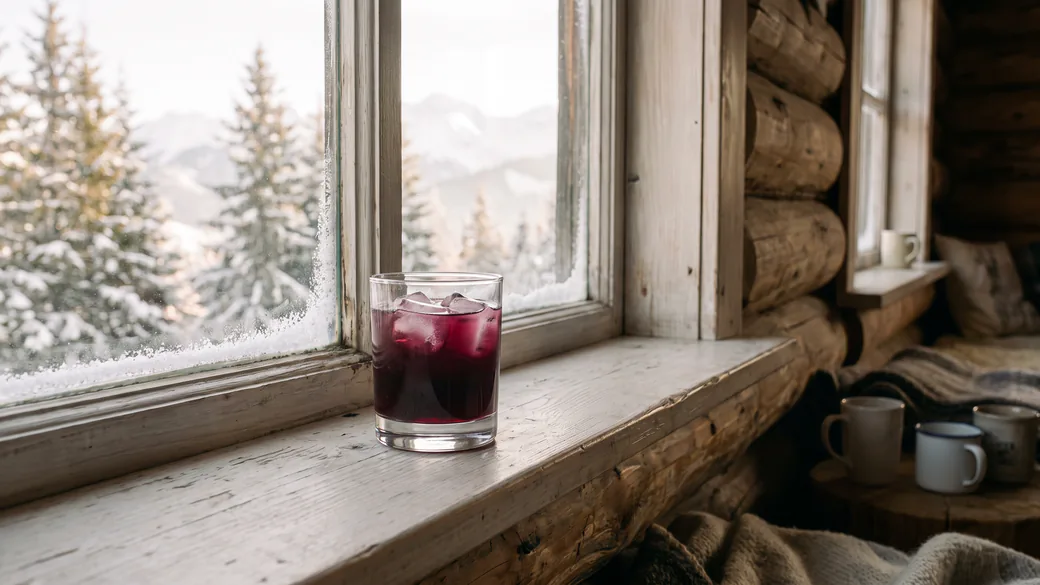
- A small drink to mark the end of the day. ATLAUA SOLACE is a 2 oz botanical shot on a berry juice base, made with eight botanical, mineral and amino ingredients. Natural ingredients. No alcohol. No cannabinoids.
More ideas, with serve suggestions, are in zero proof drinks in Colorado.
Handling social pressure
NIAAA's guidance on saying no is practical. Keep the answer short and friendly: "No, thank you." If pressed, repeat it. Do not hesitate, because hesitation gives you time to think of reasons to go along. Rehearse the line aloud beforehand, and avoid long explanations, which invite discussion.12 Holding a drink of your own, so your hands are not empty, does much of the work before anyone asks.
When an urge arrives, NIAAA suggests accepting it and riding it out, since it will crest like a wave and pass.9
What happens after the month
This is where the Dry January studies are most useful. In the 2016 follow-up, participation was related to lower consumption at six months, and very few people drank more than before.2 The 2019 cohort followed participants through to August, and the differences between completers and other drinkers were reported across that follow-up.4
The studies do not say what causes this. People who join may already be motivated to change. A sensible way to use the month is to decide, before 31 January, what February looks like: how many days you drink, and how many standard drinks on those days. Write the number down. It is easier to hold a plan than a mood.
ATLAUA's Colorado arrival is covered in ATLAUA in Colorado.
Sources
- Alcohol Change UK. Dry January about page (campaign run by Alcohol Change UK, name marked with the registered trademark symbol). Checked 27 November 2026. alcoholchange.org.uk/get-involved/campaigns/dry-january/about-dry-january
- de Visser RO, Robinson E, Bond R. Voluntary temporary abstinence from alcohol during "Dry January" and subsequent alcohol use. Health Psychol. 2016. pubmed.ncbi.nlm.nih.gov/26690637
- de Visser RO, Nicholls J. Temporary abstinence during Dry January: predictors of success; impact on well-being and self-efficacy. Psychol Health. 2020. pubmed.ncbi.nlm.nih.gov/32216557
- de Visser RO, Piper R. Short- and longer-term benefits of temporary alcohol abstinence during Dry January are not also observed among adult drinkers in the general population: prospective cohort study. Alcohol Alcohol. 2020. pubmed.ncbi.nlm.nih.gov/32391879
- Mehta G, Macdonald S, Cronberg A, et al. Short-term abstinence from alcohol and changes in cardiovascular risk factors, liver function tests and cancer-related growth factors: a prospective observational study. BMJ Open. 2018. pubmed.ncbi.nlm.nih.gov/29730627
- Centers for Disease Control and Prevention. About alcohol use. Checked 27 November 2026. www.cdc.gov/alcohol/about-alcohol-use/index.html
- National Institute on Alcohol Abuse and Alcoholism. What is a standard drink? Checked 27 November 2026. www.niaaa.nih.gov/alcohols-effects-health/what-standard-drink
- National Institute on Alcohol Abuse and Alcoholism, Rethinking Drinking. Should you cut down or quit? Checked 27 November 2026. rethinkingdrinking.niaaa.nih.gov/thinking-about-change/cut-down-or-quit
- National Institute on Alcohol Abuse and Alcoholism, Rethinking Drinking. Strategies for cutting down: tips to try. Checked 27 November 2026. rethinkingdrinking.niaaa.nih.gov/thinking-about-change/tips-try
- Ebrahim IO, et al. Alcohol and sleep I: effects on normal sleep. Alcohol Clin Exp Res. 2013. pubmed.ncbi.nlm.nih.gov/23347102
- Alcohol and Tobacco Tax and Trade Bureau. Federal Regulation of Low and No Alcohol Beverages (presentation, 2026). Checked 27 November 2026. www.ttb.gov/system/files/2026-02/Low-No_Alcohol_Products_for_TTB_web-_FINAL.pdf
- National Institute on Alcohol Abuse and Alcoholism, Rethinking Drinking. Building your drink refusal skills. Checked 27 November 2026. rethinkingdrinking.niaaa.nih.gov/tools/worksheets-more/building-your-drink-refusal-skills
This article is for general education and is not medical advice. ATLAUA products are not intended to diagnose, treat, cure or prevent any disease. Speak to a healthcare professional before starting any supplement, especially if you are pregnant or breastfeeding, take medication, or are subject to anti-doping testing.